Shandong Jisi Intelligent Equipment Co., Ltd.


How the LXA-LAUL04 Basic Workstation Supports Small-Batch Machine Tending
How the LXA-LAUL04 Basic Workstation Supports Small-Batch Machine Tending
Small-batch machining often involves frequent workpiece changes, repeated manual loading and limited production space. In these working conditions, a compact robotic workstation can help manufacturers organize workpieces, automate loading and unloading, and reduce repetitive manual handling.
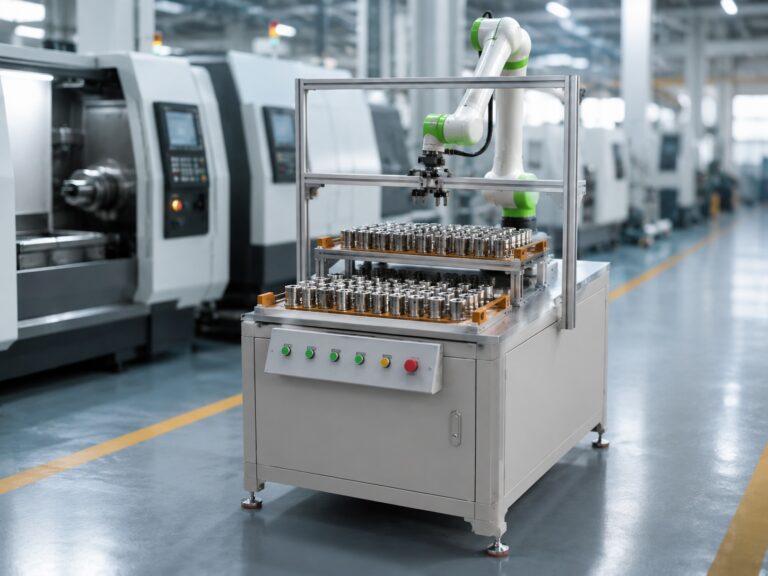
The LXA-LAUL04 basic workstation is designed for machine tending applications involving bar workpieces. It integrates a collaborative robot, open pallets, an equipment cabinet, control buttons, an alarm indicator and a robot end-of-arm fixture into one workstation.
According to the available product information, the workstation can be connected to CNC lathes or vertical machining centers and configured for 1V1 or 1V2 machine layouts.
A Modular Workstation for Small-Batch Production
The mechanical structure adopts a symmetrical frame and modular design. This structure allows the workstation to be configured according to the actual workpiece, machine tool and processing sequence.
Turning devices, workpiece reorientation devices and fixture quick-change functions can be selected according to the application. Both manual and automatic fixture change options are available.
The electrical system uses a standardized automation program intended to simplify robot commissioning and operation. The final control configuration should be determined according to the machine tool interface and the required production process.
Open Pallet Design for Workpiece Loading
The illustrated workstation uses open pallets arranged around the collaborative robot. The pallets can be positioned and replaced, allowing workpieces to be prepared and organized for robotic loading and unloading.
The listed pallet capacity is no more than 45. However, the exact quantity depends on the dimensions, spacing and arrangement of the actual workpieces. Therefore, pallet capacity should be confirmed after evaluating the workpiece drawing or sample.
The standard illustration is intended for short bar workpieces. Workpieces with different shapes require corresponding pallet and gripper designs.
Compatible Machine Tool Applications
The LXA-LAUL04 basic workstation is suitable for automated workpiece handling with the following machine tools:
- CNC lathes
- Vertical machining centers
The available standard machine layouts include:
- 1V1 layout: One robotic workstation serving one machine tool
- 1V2 layout: One robotic workstation serving two machine tools
For a 1V3 layout, the machine positions, machine dimensions and robot working range need to be simulated before determining the final configuration. Because the working range of a collaborative robot is limited, an industrial robot may need to be considered for some layouts.
Selectable Robot Fixture Configurations
The workstation supports different robot end-of-arm fixture arrangements according to the workpiece handling process.
- Single two-finger gripper
- Single three-finger gripper
- Double two-finger gripper
- Double three-finger gripper
A single-gripper configuration can be used for straightforward loading or unloading operations. A double-gripper configuration can support handling processes that require the robot to remove one workpiece and load another during the same operating cycle.
The listed workpiece weight data refers to the allowable load when a double-gripper configuration is used. The total load calculation should include the gripper, workpieces and any additional fixture components.
Available Basic Workstation Models
Two commonly used configurations are listed for the LXA-LAUL04 basic workstation:
| Parameter | LXA-L01-F-R12-1300 | LXA-L01-D-R20-1800 |
|---|---|---|
| Workstation Series | Basic workstation | |
| Pallet Configuration | Single pallet configuration | Double pallet configuration |
| Pallet Type | Positionable and quick-change pallet | |
| Pallet Capacity | ≤45, depending on actual workpiece dimensions | |
| Fixture Quick-Change Method | Manual or automatic | |
| Compatible Fixture Types | Single two-finger, single three-finger, double two-finger or double three-finger gripper | |
| Compatible Workpiece Type | Bar workpieces | |
| Compatible Machine Tools | CNC lathe or vertical machining center | |
| Machine Layout | 1V1 or 1V2 | |
| Standard End-of-Arm Fixture | One set | |
| Robot Rated Payload | 12 kg | 20 kg |
| Maximum Working Radius | 1300 mm | 1800 mm |
| Repeat Positioning Accuracy | ±0.03 mm | ±0.05 mm |
| Robot Protection Rating | IP65–IP68 | |
| Maximum Workpiece Height | ≤140 mm | |
| Maximum Workpiece Diameter | ≤60 mm | ≤80 mm |
| Maximum Workpiece Weight | ≤3 kg | ≤6 kg |
Understanding the Model Designation
The model designation provides information about the workstation and robot configuration.
Using LXA-L01-F-R12-1300 as an example:
- LXA-L01: Basic material storage workstation series
- F: Single-pallet configuration
- D: Double-pallet configuration
- T: Three-pallet configuration
- R12: Robot with a rated payload of 12 kg
- 1300: Robot working radius of 1300 mm
The workstation model should be selected according to the workpiece weight, dimensions, pallet arrangement and required robot working range.
Key Information Required Before Workstation Selection
To evaluate whether the LXA-LAUL04 basic workstation is suitable for a machining project, the following information should be provided:
- Workpiece drawing or sample
- Workpiece material and shape
- Workpiece diameter, height and weight
- Required pallet quantity and pallet capacity
- Machine tool type and model
- Machine door opening position
- Loading and unloading position
- Single-gripper or double-gripper requirement
- Manual or automatic fixture change requirement
- Number and arrangement of connected machine tools
- Available installation space
- Required machining and handling sequence
Supporting Flexible Machine Tending
The LXA-LAUL04 basic workstation is intended for small-batch production environments that require automated loading and unloading of bar workpieces.
Its modular frame, selectable pallet arrangement, quick-change fixture options and different robot payload configurations allow the workstation to be adapted to different CNC lathe and vertical machining center applications.
The final robot, gripper, pallet and machine layout should be selected according to the actual workpiece dimensions, machine tool arrangement and production process.